



How to Spec Bathtubs for a Multi-Room Hotel Renovation
Specifying bathtubs for a multi-room hotel renovation means defining every dimension, finish, and installation detail before a single unit is ordered. A complete spec sheet locks in consistency across rooms, prevents costly mid-project substitutions, and gives manufacturers what they need to quote accurately. Get the spec right upfront, and the rest of the procurement process follows a predictable path.

Why Spec Sheets Matter More in Hotel Projects Than in Residential Work
A residential bathroom renovation might involve one or two bathtubs. A hotel renovation can involve dozens or hundreds — often across room categories that share the same floor plan but carry different brand tiers. In that context, a vague spec is not a minor inconvenience; it is a multiplied risk. One ambiguous dimension, replicated across a hundred rooms, produces a hundred installation problems.
For hospitality buyers sourcing OEM/ODM bathroom fixtures, the spec sheet is the single document that aligns the design team, the procurement team, the manufacturer, and the on-site installers. It needs to be precise enough that anyone reading it can answer every practical question about the unit without making assumptions.
How to Build a Hotel Bathtub Spec Sheet
A hotel bathtub spec sheet is only useful when it covers every dimension and finish detail — vague specs produce vague quotes and expensive rework.
At minimum, a standard product specification for a hotel bathtub should include the following fields:
- Outer dimensions — overall length, width, and height of the unit as it will sit in the room
- Internal basin dimensions — the usable interior length and width, which determine the guest experience
- Water depth — the maximum fill depth measured from the drain floor to the overflow point
- Drain position — centered, end, or offset, referenced to a consistent corner or edge
- Overflow type — integrated slot, pop-up trim, or overflow-free design depending on the installation type
- Wall thickness — relevant to both structural performance and how the unit interacts with surrounding tile or cladding
- Finish — matte, gloss, or textured; color reference; any anti-slip surface treatment on the basin floor
Beyond these core fields, hotel projects benefit from adding installation notes — rough-in dimensions, floor load requirements, and any clearances needed for freestanding floor-mount fillers. If the property runs multiple room categories, create a separate spec sheet per category rather than trying to accommodate variations in a single document. The more a spec sheet tries to cover, the less reliable it becomes for any one application.
For projects involving custom solid surface fabrication, the spec sheet also needs to capture any non-standard profile details — apron angles, integrated ledge dimensions, or custom colorways — so the manufacturer can confirm feasibility before production begins.
Understanding Lead Times for Custom Solid Surface Orders

One of the most consistent planning errors in hotel renovation bathtub sourcing is treating custom solid surface units as if they were stock plumbing fixtures. They are not. Custom solid surface pieces are fabricated to order, and lead times reflect that. Procurement timelines should reflect that custom solid surface orders take longer than stock items; planning this gap is what keeps renovations on schedule.
The practical implication: procurement for a hotel bathroom renovation should begin well before the construction schedule demands product on-site. The spec sheet needs to be finalized, samples approved, and the purchase order placed early enough to absorb the full production and shipping window. Any scope change after production starts — a dimension adjustment, a finish change, a drain position revision — resets that timeline.
When planning a phased renovation, where floors or wings are completed in sequence, coordinate delivery schedules with each phase start date rather than ordering everything at once. This keeps storage requirements manageable and reduces the risk of damage to units waiting on-site for extended periods.
Bulk Ordering: Cost Advantages and Logistics Realities
Bulk ordering is standard practice in hotel renovation bathtub sourcing, and the per-unit cost benefit is real. However, bulk orders require careful consideration of two factors that are easy to underestimate: warehouse space and impact protection.
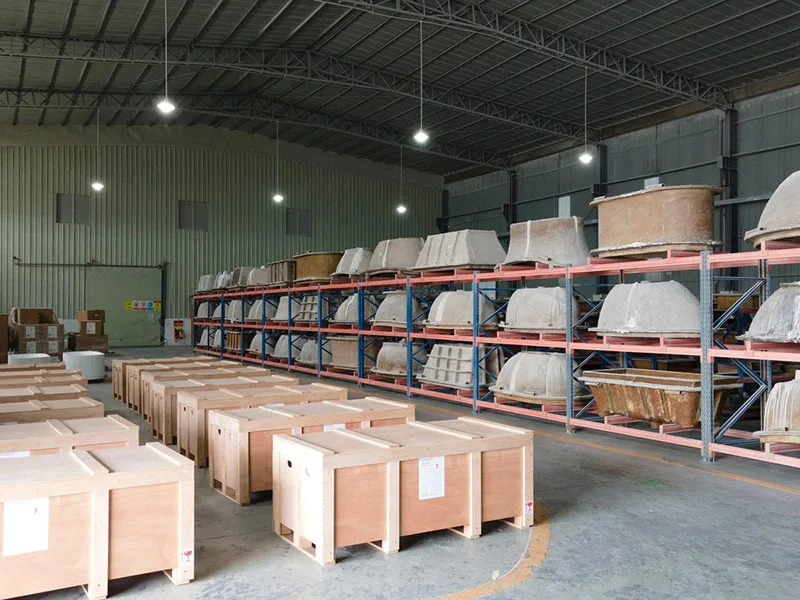
Solid surface bathtubs are bulky. A full hotel order occupies significant floor area and height in a warehouse or staging area. Units need to be stored flat or on purpose-built racks with adequate padding between pieces. Stacking without proper impact protection damages finished surfaces — and a cosmetic defect on a solid surface unit is not always easy to repair in the field. Factor protected storage into the logistics plan before finalizing order quantities and delivery windows.
For projects where the renovation timeline is compressed, it may be worth coordinating with the manufacturer on phased delivery — receiving units in batches aligned to the installation schedule rather than a single large shipment. This reduces storage burden and limits the window during which units are at risk of on-site damage.
Coordinating Spec, Supply, and Schedule
A well-run hotel renovation bathtub sourcing process comes down to three things arriving in the right order: a locked spec before quotes are requested, a purchase order placed far enough in advance to honor the production lead time, and a delivery schedule that matches the installation sequence on-site.
Working with a manufacturer like OLEARY — which specializes in custom solid surface bathroom fixtures for the hospitality market — means the specification process is a dialogue, not a one-way submission. Design questions, material feasibility, and finish options are resolved before production, not during it.
If you are in the planning stages of a property renovation and need to align specs with budget and timeline, request a hotel project quote to start that conversation with dimensional requirements and room counts in hand. The earlier a manufacturer is brought into the process, the more accurately the procurement schedule can be built around real lead times rather than optimistic assumptions.